Underground Sewer Diagnostics and Structural Restoration
Few household plumbing emergencies are as disruptive as a main sewer line failure. When wastewater backs up through basement floor drains, utility sinks, or ground-level fixtures, the entire building's sanitation is compromised. Providing dependable sewer line repair Ditmars-Steinway Queens requires advanced diagnostic imaging combined with a clear understanding of New York City municipal sewer regulations and property-owner boundary obligations.
Warning Signs of Main Sewer Line Failure
An underground sewer compromise develops over months before total failure occurs. Property owners should watch for these critical indicators:
- Simultaneous Multi-Fixture Backups: Unlike an isolated kitchen sink clog, a main sewer obstruction affects all building drains. Running water on upper floors causes lower-level toilets to bubble and tub drains to fill with murky water.
- Persistent Sewer Gas Odors: Smelling hydrogen sulfide gas inside cellars, driveways, or front yards indicates a cracked pipe allowing sewer vapors to escape through soil.
- Exterior Ground Settlement: Unexplained sunken depressions or cracked concrete slabs on front walkways often indicate that an underground sewer break is washing surrounding soil into the city sewer pipe.
- Chronic Root Intrusions: If routine drain cleaning clears a clog only for backups to recur every few months, aggressive tree roots have penetrated mortar joints in vintage vitrified clay sewer pipes.
NYC DEP Property Owner Responsibilities
Many property owners mistakenly assume that the New York City Department of Environmental Protection (DEP) maintains the sewer pipe once it crosses the front property line into the street. In New York City:
Property owners own and are solely responsible for the entire private sewer house connection lateral. This legal responsibility extends from the inside basement foundation wall, under the front yard and public sidewalk, across the street curb line, and out to the connection point (spur) on the municipal sewer main in the middle of the roadway. When a private line collapses in the roadway, the owner must hire an NYC Licensed Master Plumber to obtain emergency street opening permits from the Department of Transportation (DOT) and execute the repair.
Experiencing Main Sewer Backups?
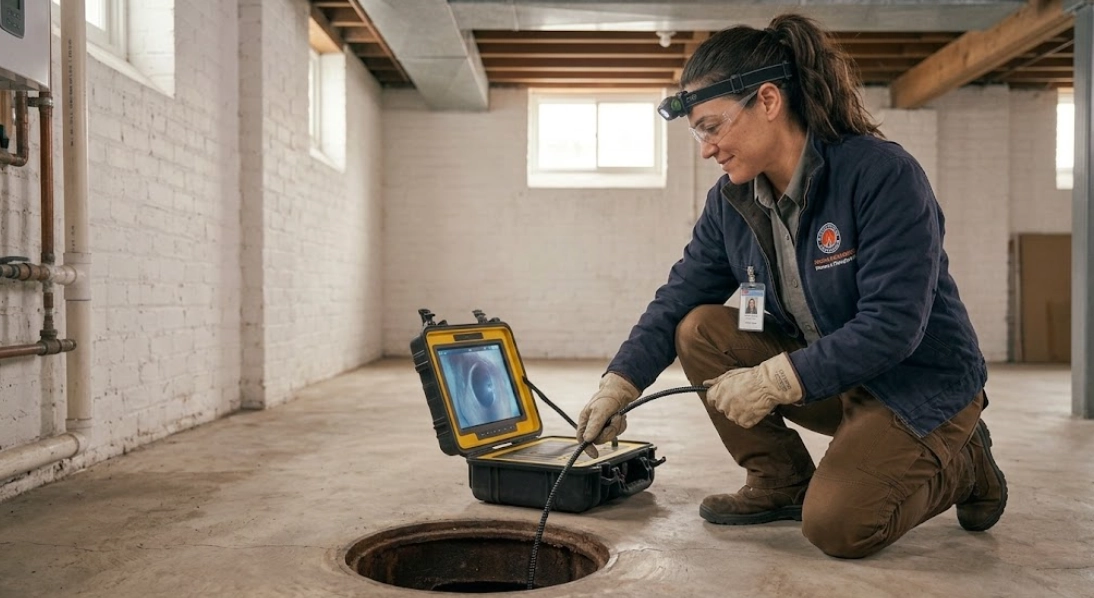
Our technicians perform high-definition video camera inspections to locate breaks and determine whether spot repairs are viable.
Video Camera Inspection and Sonde Locating
Modern sewer repair eliminates guesswork through robotic pipe endoscopy:
- High-Resolution Waterproof Camera: A flexible camera head with powerful LED illumination travels through the basement cleanout, recording real-time footage of pipe walls, grease accumulation, cracked joints, and root penetration.
- Distance Counter: Tracks the exact footage from the cleanout, identifying precisely where the obstruction or structural failure lies.
- Integrated 512 Hz Locating Sonde: Emits an electromagnetic signal detected by a handheld wand receiver above ground. This reveals the exact surface location and depth (whether two feet beneath the cellar floor or eight feet under Ditmars Boulevard asphalt), allowing pinpoint excavation without digging up the entire yard.
Spot Repairs vs. Full Lateral Replacement
After completing the camera survey, technicians present practical engineering options:
- Surgical Spot Repair: If the structural fracture is limited to a single cracked section beneath the front garden while the remainder of the extra-heavy cast-iron line is in sound condition, targeted excavation replaces only the damaged section with new hubless cast iron secured with stainless-steel shielded couplings.
- Full Line Replacement: When vintage clay tile has collapsed across multiple joints, suffers severe back-pitch (sagging bellies), or has disintegrated from heavy traffic loads, complete lateral replacement from foundation to street connection is necessary to avoid perpetual emergency visits.
Preventing Basement Backups with Backwater Valves
During heavy summer thunderstorms, New York City combined stormwater and sanitary sewers can become overwhelmed, causing street water to surcharge backwards into low-lying basements. Installing a code-compliant automatic backwater check valve on the house drain allows wastewater to exit normally while creating a watertight barrier that prevents city stormwater from flooding cellars. If water intrusion does compromise walls, review our leak detection services for non-destructive moisture tracing.
Frequently Asked Questions About Sewer Line Repair
Older Queens properties utilized vitrified clay pipes joined in three-foot sections sealed with cement mortar. Over decades, ground shifting and thermal expansion crack the mortar. Tree roots seek out the moisture and nutrients vaporizing through these hairline gaps, sending micro-roots inside that rapidly expand into dense, pipe-choking root balls.
A sewer belly is a sagging section of pipe where the supporting soil beneath has eroded, causing the line to dip below proper slope. Water pools in the belly, slowing flow velocity and allowing solids and toilet paper to settle. While a snake can temporarily punch through accumulated waste, a belly will continually cause backups until the sagging pipe is excavated, re-bedded with gravel, and re-pitched to proper grade.
Yes. Any repair or replacement of an underground sewer lateral requires permits filed by a Licensed Master Plumber with the NYC Department of Buildings (DOB), NYC DEP, and if work extends past the property line, street opening permits from the NYC Department of Transportation (DOT).
Speak Directly With a Local Sewer Specialist
Schedule a diagnostic video camera inspection or discuss lateral repairs for your Ditmars-Steinway property.